 Sideline SideKick Tracker
Coach's Read is the timeout, halftime and Saturday-morning screen. It is your own tendencies, read off the plays you have already logged — not scouting on somebody else. Everything on it is computed on your own phone from your own game.
What it is
You are already keeping the play-by-play. Coach's Read is what that record is worth once there is enough of it: which calls are moving the ball tonight, which have stopped, and what an opposing coordinator with a notepad can already tell about you.
It is a coaching screen, not a report. Fans never see it, and the owner can switch it off for the whole staff in Team Settings.
Two ways in, and why they open differently
- From the game screen — the Coach's Read card. It opens on This Game, because that is the between-series glance it exists for.
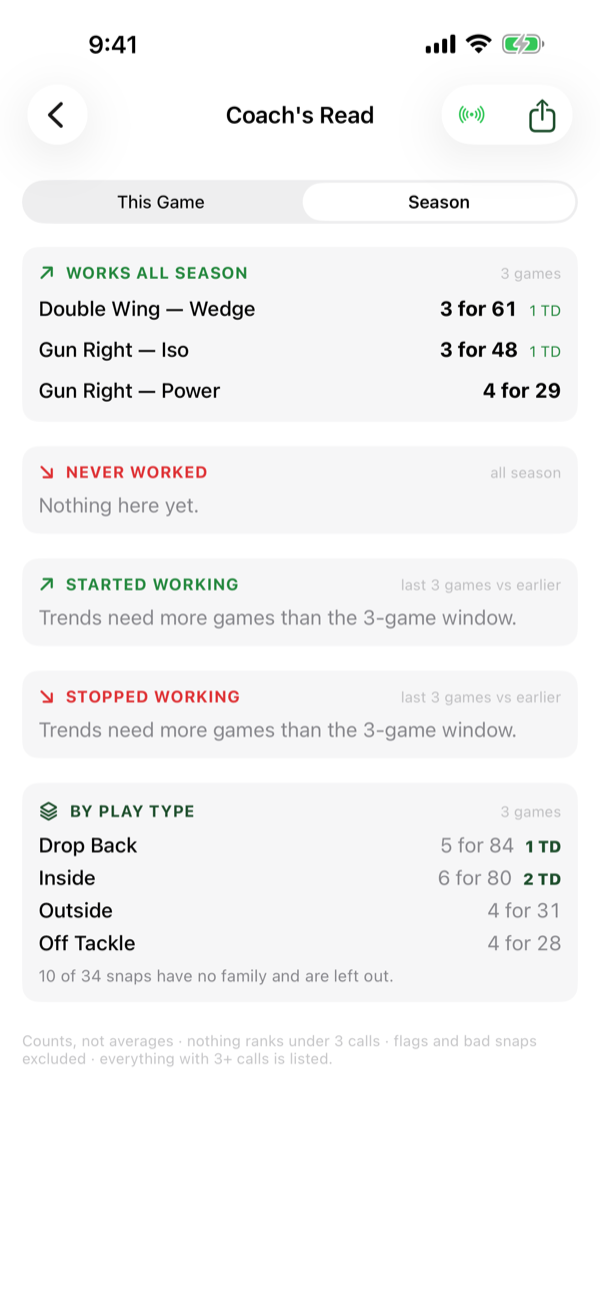
- From the home screen — the Coach's Read door. It opens on Season, because a coach reaching for it on a Tuesday is asking about the year, not about a Friday that has not happened yet.
The This Game / Season switch is at the top either way, and it stays where you put it.
The rules it plays by
These are printed at the bottom of the screen, and they are worth understanding once because they explain everything the screen does and does not say.
| Rule | Why |
|---|---|
| Counts, not averages | "6 for 41" is a thing a coach can hold in his head. "6.8 yards per carry" is a thing he has to unpack. |
| Nothing ranks under 3 calls | Two carries for 22 is not a read, it is a long run. Below three it is an anecdote, and a read you cannot trust is worse than none. |
| Everything with 3+ calls is listed | The screen does not pick favourites once a call clears the floor. |
| Flags and bad snaps excluded | One holding call should not make your best play look broken. |
| Nothing appears before about 10 plays | Same reason as the three-call floor, applied to the game as a whole. |
This Game
WORKING · GONE COLD
Your calls, ranked. WORKING is 3+ calls ranked by yards per call. GONE COLD is 3+ calls averaging two yards or less — the plays you are still calling that have stopped paying.
BY PLAY TYPE
The same reading, pooled by play family. Power and Counter are two calls and one read, so this is the section that has something in it early: families reach three uses long before any single call does. On a night when the call table is honestly empty, this is the one to look at.
It only works if your plays are tagged. If yours are not, this section says so and tells you where to fix it.
FIELD POSITION
Your average drive start tonight, and — in Season scope — what it is across the year, so you can see whether tonight is unusual.
BY QUARTER
Eligible snaps and yards, quarter by quarter.
What they can see — the self-scout
The section that earns the feature. It looks at this half and tells you what somebody in the opposite press box has already written down, in the words they would use.
Two things trigger it:
- Direction. "You're telegraphing right. 11 of 14 directional plays this half have gone right — 79% — and their edge will start cheating that way."
- Run/pass balance. "You're 78% run this half — 18 of 23. Expect an extra man in the box until you make them pay for it."
Above the warnings are direction bars, and under them the plain run–pass count for the half. When there is nothing to flag the screen says so — "Nothing standing out — your calls are balanced enough that there's no obvious key" — which is a genuine answer rather than an empty box.
It reads this half, not the whole game, and that is the point. A tendency you broke at halftime is not a tendency any more, and a screen that kept counting the first half would keep warning you about a problem you already fixed.
Season
Different questions, so different sections.
- WORKS ALL SEASON · NEVER WORKED — the same two lists over the year rather than the night.
- STARTED WORKING · STOPPED WORKING — the last three games measured against everything before them. Each row shows both numbers: "7 for 63, last 3" above "Earlier: 11 for 34". This is where you find the call that has quietly gone off, and the one the install finally took on.
- BY PLAY TYPE — families, across the season.
Season scope loads your other games the first time you switch to it, so give it a moment on a slow connection. Tonight's game is included and is counted once — a live game that is still gaining plays does not get double-counted into the year.
When a section is empty
Every empty state on this screen tells you why rather than looking broken, and most of them are actionable:
| It says | Do this |
|---|---|
| "Tendencies appear after about 10 plays" | Nothing. Keep logging. |
| "None of your plays have a family yet" | Tag them in the playbook. One afternoon, once. |
| "Nothing has been called three times yet" | Nothing. The three-call floor is doing its job. |
| "This Game reads the game on your Game tab" | Switch to Season, or open a game first. |
Sharing it with your staff
The share button in the top right sends the read as plain text — exactly the scope you are looking at, so the message and the screen cannot disagree.
This document is made of your formation and play-call names. Send it to your staff, not to an athletic director or a parent. The postgame report is the one built to go outward — it cannot name a single one of your calls, which is exactly why it is safe to mail. The two are deliberately kept on different screens so you cannot send the wrong one.
The share button is not shown to fans at all.
The two-device sideline
Coach's Read reads the same live game your play entry writes to, so this costs you nothing to set up: an assistant enters plays on an iPad while the coordinator keeps this open on a phone. It updates as plays land.
It is also a pushed screen rather than a pop-up, so opening it on the same device does not block the assistant entering the next play behind it.